
Carroll Projected and Actual Release
MDOC uses the exact label Tentative Release Date on its public offender detail. The agency's Family and Friends Guide defines the date as the expected release from incarceration after adjustments for earned time or time-served credit. Maximum discharge is the expected sentence endpoint without early-release allowances. Neither label should be changed into “guaranteed release date.”
Actual release is a past event. It is supported by a release entry from Sheriff Clint Walker's office for county custody or by an MDOC final status, discharge certificate, or releasable time-sheet entry for state custody. A tentative date in the past is still not enough by itself. The person may have had a detainer, lost credit, received a later order, transferred, or entered community supervision.
A Carroll County pretrial detainee is different. Bond and court action can authorize release without any MDOC calculation. The facility record provides the physical departure, while the court docket provides legal authority. No Carroll-specific county good-time policy was found, so a state earned-time formula cannot be applied to a local detainee.
Find Carroll County Projected Release
Begin by asking whether the person at Carroll County Regional Correctional Facility was held as a county detainee or as an MDOC-sentenced offender. The building serves both. A state offender can be housed in Vaiden while MDOC controls sentence computation. A county detainee can leave on bond without ever appearing in the state offender system.
- Identify the last legal custodian and obtain the person's MDOC number, booking number, or court case number when possible.
- For an MDOC offender, search the MDOC inmate system by exact ID or name.
- Open the matching detail and compare date of birth, offense, sentence, Carroll conviction data, entry date, location, and unit.
- Read “Tentative Release Date” exactly. Also note the location-change date and sentence structure, but do not treat them as release.
- For county custody, contact the Vaiden facility and inspect the proper Carroll court order instead of applying the MDOC date.
- If the answer remains unclear, request the final state time sheet or county release entry from the responsible custodian.
The official MDOC example detail shown below demonstrates the field label and related offender information. It is an interface example, not evidence about the current release of the named sample person.
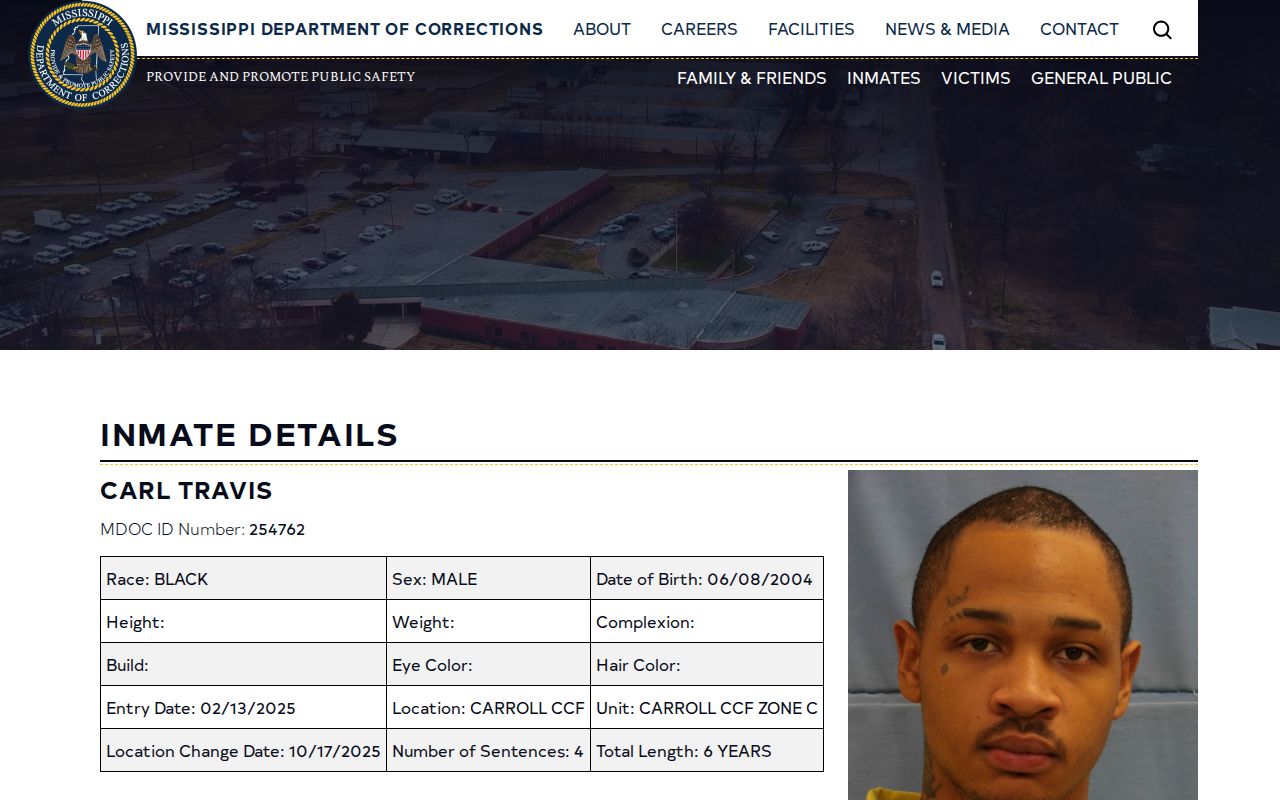
The location, sentence, and tentative-date fields must be read together, then checked against a final agency record.
Note: A blank MDOC tentative date does not mean life, denial, or no future release unless another official record says so.
Carroll MDOC Release Date Computation
MDOC performs the official time computation. The safe concept begins with the court sentence and lawful sentence-begin date. Eligible pre-sentence jail credit is applied only under the governing rules and cannot be duplicated. Concurrent sentences run together to the extent the orders provide; consecutive terms run in sequence. The calculation then accounts for earned-time eligibility, mandatory limits, exclusions, forfeitures, detainers, and conditional-release programs.
Relevant Mississippi laws include Miss. Code § 47-5-138 for earned-time allowance, § 47-5-138.1 for earned release supervision, § 47-5-139 for exclusions and forfeiture, and § 47-7-3 for parole eligibility. The official Mississippi law gateway should be checked for the current text that applies to the offense and sentence date. Reforms and effective dates matter.
Mississippi's historic “85 percent” shorthand came from a limit that capped ordinary earned-time reduction at 15 percent for certain sentences after June 30, 1995. It is not a rule that every person today serves exactly 85 percent. Parole, ERS, day-for-day provisions, excluded offenses, habitual status, jail credit, sentence structure, forfeiture, amendments, and holds can produce another answer. A public calculator cannot resolve those legal and administrative inputs.
MDOC's handbook says the time-computation function establishes parole dates, ERS dates, tentative release or discharge dates, and maximum release dates. Eligible county jail time must relate to the cause for which the person is incarcerated, and duplicate credit is not allowed. The earliest sentence date, offense date, sentence date, and the wording of each judgment all matter. A Carroll County court order may state jail credit, but MDOC still performs the official state calculation. If the public detail conflicts with the expected arithmetic, request the releasable time sheet instead of revising the date through a personal estimate.
- Earned time
- A sentence credit allowed under the applicable statute and MDOC rules.
- ERS
- Conditional community placement in which the person keeps inmate status under MDOC jurisdiction.
- Jail credit
- Eligible pre-sentence custody time credited to the sentence under the controlling rules.
- Detainer
- A request or authority from another agency that may prevent ordinary community release.
Why Carroll Release Dates Change
A tentative date moves when one of its inputs changes. The cause must be traced to an official sentence, time-computation, supervision, or custody record. A public screen may display the updated date without explaining every calculation step. Request the releasable time sheet or final status when the reason matters.
| Factor | Possible effect | Best confirming source |
|---|---|---|
| Eligible earned time | May advance the anticipated incarceration exit | MDOC time computation |
| Credit loss or forfeiture | May move the tentative date later | MDOC calculation and applicable decision record |
| Concurrent or consecutive terms | Changes the combined sentence span | Sentencing orders and MDOC time sheet |
| Pre-sentence jail credit | May change the sentence-begin computation | Court order and MDOC calculation |
| Detainer or another hold | Can block community release or cause transfer | Holding and receiving agencies |
| Parole or ERS action | May permit conditional community placement | Board or MDOC status record |
| Amended or revocation order | May revise custody or supervision terms | Filed court or Board record |
ERS is discretionary. The MDOC handbook also lists several exclusions and unresolved conditions, including categories tied to habitual sentences, specified offenses, mandatory terms, certain detainers, forfeiture, and ERS violations. It is safer to consult the current statutes and the person's MDOC record than to reduce eligibility to a broad offense label.
A transfer can also make a projected date appear misleading when location is read without status. An MDOC offender who leaves Carroll County Regional Correctional Facility may appear at another state unit while the same sentence continues. The location-change date records movement inside the system. It does not prove parole, ERS, discharge, or community release. If another county, ICE, or a federal authority assumes custody, the departure date and the eventual community-release date can belong to different custodians.
Carroll MDOC Release Takes 30–45 Days
Official MDOC guidance says state release processing can take 30–45 days. During that process, a case manager informs the inmate of the date and verifies travel arrangements. The person must receive a discharge certificate before release. If bus travel is requested, MDOC may buy a ticket to the destination or nearest city, but the guide says it does not purchase out-of-state travel.
This processing period explains why a Tentative Release Date is not a confirmed gate event. Planning tasks and document checks can continue even when a public date is near. A parole grant may also precede the actual exit because residence verification, travel work, a detainer, or another condition remains unresolved. The state date should be treated as pending until MDOC confirms the release category and event.
The 30–45 day guidance applies to MDOC releases. It is not evidence about Carroll County bond processing, the hour when county detainees leave, a family waiting area, or weekend release practice. None of those local details was verified. County bond-outs remain governed by the court authority and the sheriff or facility release entry.
Note: State release preparation and county bond release are distinct processes even when both people were housed at the Vaiden facility.
Carroll Parole Dates and Discharge
Parole eligibility, a Board hearing, a grant, physical release, supervision start, and maximum discharge are separate dates. The Mississippi State Parole Board decides parole. MDOC calculates the relevant sentence dates and Community Corrections supervises the person after parole. A grant does not guarantee the same-day physical exit.
Search the MDOC Parolee Search after a possible parole release. It accepts name, MDOC ID, city, and county. A match supports current parole status, not full sentence discharge. An absence can reflect a mismatch, another supervision type, delayed data, discharge, or no MDOC history. Request the Board action and final MDOC status when the date sequence matters.
Probation is different. It comes from the court and may follow a suspended sentence or exist without a state-prison commitment. A county detainee released on bond has not become a parolee merely because the person left Carroll County Regional Correctional Facility. Always identify the legal status before selecting a date source.
The Board's rules add another date layer. Required hearings can occur in the eligibility month or one of the two prior months, and the Board may decide by file review, in person, by telephone, or by teleconference. The July 2026 sweep found no official public hearing calendar or individual decisions search. Request the named action from the Board. Do not treat the MDOC Parolee Search as a decision record, and do not treat an eligibility month as a granted or completed release.
Confirm Carroll County Release Dates
For county detention, consult the official Carroll facility page, call 662-464-5440, and ask whether the person was released to the community, transferred, or held under another location. The Carroll County directory identifies the sheriff and local courts. Request the sheriff release entry for the actual date, time, reason, authority, and transfer destination. Inspect the correct file through the Carroll Circuit access point or the charging Justice Court for bond, dismissal, sentencing, credit, revocation, or completion terms.
For an MDOC offender, request the final release or discharge date, release category, discharge certificate or releasable time-sheet entry, and last location. MDOC requests must be written; the MDOC records portal is the official submission route identified in the research. A location change is not an actual release date.
A narrow written request is more useful than asking for every record. Provide the full name, MDOC number, date of birth, and commitment when known. Ask for the final release or discharge date, category, discharge certificate, releasable time-sheet entry, and last MDOC location. If the state record does not apply because the person was a county detainee, ask the sheriff for the booking sheet and the release event instead. The request should seek the date and time, release reason, releasing authority, and transfer destination if the departure was a transfer.
VINELink can add notice of a pending custody event. Registration and event-reading steps are covered in the Carroll County VINELink Inmate Search. An alert remains agency-reported evidence, so compare it with the direct custody record and court authority.