
Carroll Parole and Probation Compared
Mississippi separates the decision to grant parole from the work of supervision. The Mississippi State Parole Board makes parole decisions. The Mississippi Department of Corrections calculates sentence dates, while MDOC Community Corrections supervises parolees and probationers. Probation usually comes from a court sentence. It may begin without a state-prison term, or it may follow a suspended part of a sentence. Neither status should be inferred just because a person left the Vaiden facility.
A Carroll County release record tells when and why county custody ended. A supervision record tells whether conditions continue in the community. Maximum discharge is different again: it marks the endpoint of the state sentence computation. Parole is not a pardon, an acquittal, or the same as discharge.
| Status | Who creates it | What to verify |
|---|---|---|
| Parole | Mississippi State Parole Board | Board action, MDOC parolee result, and supervising office |
| Probation | Sentencing court | Court order, term, and Community Corrections status |
| Earned Release Supervision | MDOC under the earned-time framework | Eligibility, approved status, and MDOC supervision |
| Maximum discharge | MDOC sentence computation | Final discharge record or certificate |
- Parole
- Conditional community release approved by the Board before sentence discharge.
- Probation
- Court-ordered supervision that may exist with or without a prior prison term.
- Absconder
- A person alleged to have stopped reporting or left supervision without authorization.
- Discharge
- The recorded end of the sentence or supervision obligation.
Verify Carroll County Post-Release Supervision
The official starting point is the MDOC Parolee Search. It accepts first name, last name, MDOC ID, city, and county. An exact MDOC number is the strongest key. When only a name is known, compare identifiers and sentence details before treating a result as the same Carroll County person. A match is affirmative evidence that MDOC identifies the person as a parolee. It is not proof that the sentence has ended.
- Decide whether the person was a county detainee or an MDOC-sentenced offender at Carroll County Regional Correctional Facility.
- Search the MDOC parolee tool by MDOC ID when available. If using a name, check spelling and compare all returned identity fields.
- Read the status literally. Do not turn parole, ERS, probation, or a location change into full discharge.
- Check the sentencing order when probation or post-release supervision may be court imposed.
- Contact MDOC and ask for the Community Corrections office responsible for the case and for releasable status confirmation.
- Request the final discharge date or record in writing when the public result does not settle the question.
The MDOC home page shows the public parolee-search entry point illustrated below. The search fields belong to the state system, not to a county bond roster.
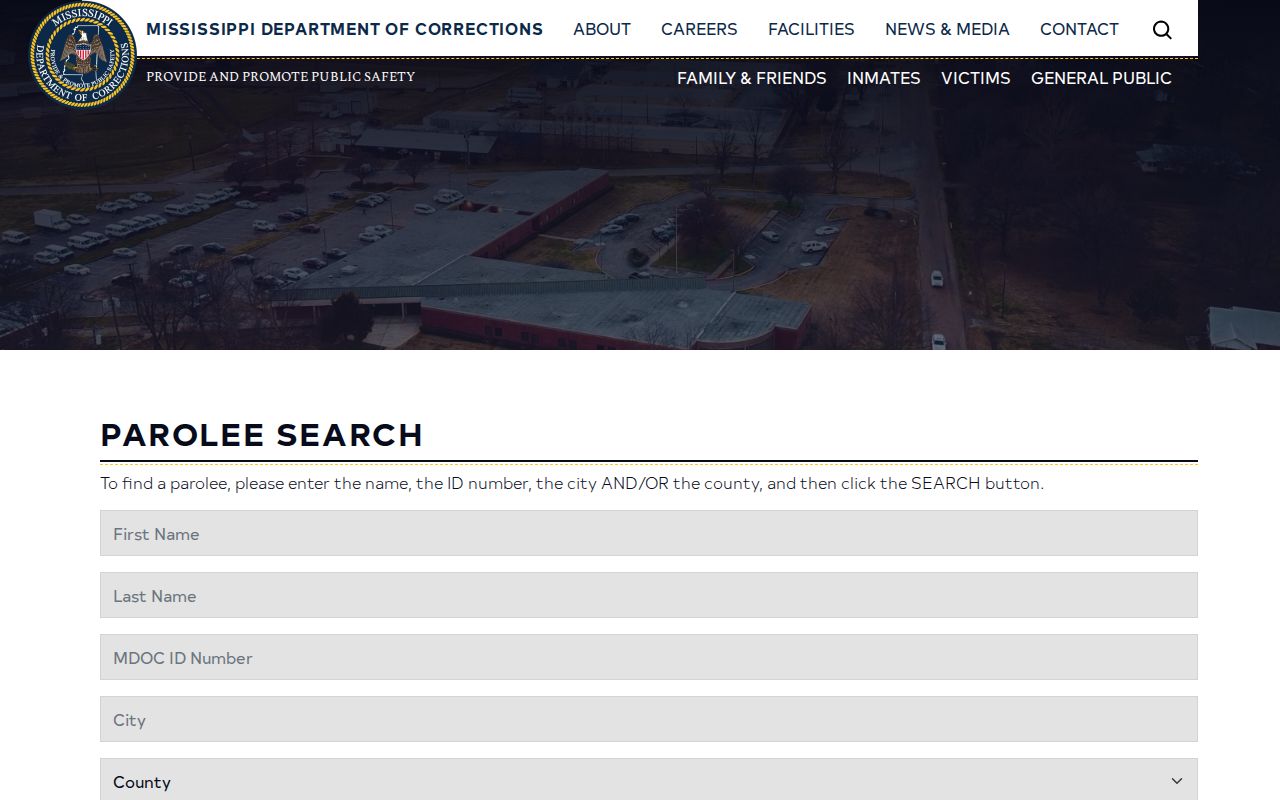
A result should be reconciled with the court order and current MDOC record before a supervision claim is treated as confirmed.
For the full county-release and court-record path, use the Carroll County released-inmate search. That path is vital when the person was never committed to MDOC.
Note: Absence from the parolee search can reflect discharge, another status, a name mismatch, a delayed update, or no MDOC history.
Carroll Supervision Contact Routes
No named Carroll County Community Corrections field-office address was verified in the research. The safe route is through MDOC central contact, which can identify the responsible office. Provide the MDOC number when known and keep the request limited to public status and routing information. The Records Department handles written state release and discharge records. The Parole Board handles its own actions, hearing questions, and minute records.
Mississippi Department of Corrections301 North Lamar Street
Jackson, MS 39201
601-359-5600
MDOC contact page MDOC Records Department
601-933-2889
MDOCRecordsDepartment@mdoc.state.ms.us
Written records portal Mississippi State Parole Board
239 North Lamar Street, Suite 501
Jackson, MS 39201
601-576-3520
MSStateParoleBoard@mdoc.state.ms.us
The Board and MDOC are separate agencies for key purposes. Calling MDOC about day-to-day supervision does not replace a Board action record, and asking the Board about an action does not replace current Community Corrections verification.
Carroll Parole Hearing Records
Mississippi parole eligibility is governed in part by Miss. Code § 47-7-3, with offense, sentence date, and exclusion rules that prevent a universal percentage calculation. The Board's administrative rules state that required parole hearings occur no later than the month before eligibility, allowing consideration in the eligibility month or in the prior two months. A hearing may proceed through file review, in person, by phone, or by teleconference at Board discretion. The inmate is not present for Board deliberation.
The July 2026 research sweep found no current official public hearing-calendar URL and no official individual decision-results search. The MDOC Parolee Search must not be relabeled as a Board decision database. Ask the Board for the hearing date or action. For a releasable official action or minute, use the Board contact and the MDOC written-record route as directed. Possible records can say grant with conditions, denial, deferral, rescission, or revocation, but only the terms in the named person's record should be repeated.
Board Rule 3.3 identifies situations that require a hearing, including specified violent offenses, case-plan compliance issues, a victim request after notice, or a supported request from relevant law enforcement. Rules on eligibility and procedure do not establish an outcome for a named Carroll County person. Miss. Code sections 47-7-13, 47-7-15, 47-7-17, and 47-7-18 address Board decisions, records, notice, and processing. The Board must keep minute-book records of official actions and reasons. A focused request should therefore ask for the hearing date, the final action, and the releasable minute or reason rather than seeking an unsourced public calendar that the state does not provide.
A grant does not by itself establish the day a person walked out. Residence checks, travel planning, detainers, and other release work may still be pending. The physical release and the Board action are separate facts.
Carroll Supervision Violations and Absconders
An absconder label reports an alleged supervision problem. It is not a new conviction, and it does not prove that the person is now in jail. The local sweep found no Carroll County public absconder list. Do not substitute social posts or an unofficial warrant page. Verify the source status through MDOC, then check the responsible court or custodian if a warrant or return to custody is at issue.
Mississippi SAVIN can issue event notices for abscond supervision and return to custody after absconding. Those alerts are useful event evidence, but closely spaced electronic file updates can create more than one notice. A VINE event should be checked against the agency record. Conditions and violations may affect supervision or lead to revocation, yet the exact consequence comes from the Board or court record, not from a general rule.
Note: A missing parolee-search result is never enough to label a person discharged, in violation, or back in custody.
Vaiden Release Is Not Supervision
Carroll County Regional Correctional Facility holds both county detainees and state-system offenders under a regional partnership. Sheriff Clint Walker's office operates the building, while MDOC places and oversees state inmates. Legal custody determines the correct record. A county detainee who posts bond may leave the same Vaiden address as an MDOC parolee, but their post-release records are not alike.
For the county detainee, use the official Carroll County directory to route a sheriff request, then inspect the proper court order through the Fifth Circuit Carroll access point. Bond does not automatically create MDOC supervision. For the state offender, search the MDOC inmate record, then the parolee tool when parole is possible. ERS also keeps the person under MDOC jurisdiction. A move from Carroll to another MDOC unit is a transfer, not community release and not the start of parole.
This distinction is Carroll County's key safeguard against a false supervision claim. Start with the person's legal status, not just the shared street address.
Carroll Release and Reentry Programs
MDOC describes regional facilities as providing educational, treatment, faith-based, and reentry programming. The source does not name a current Carroll County community provider, nor does it promise a referral for each person released from the Vaiden facility. That limit matters. A broad state program statement should not become a made-up local service list.
Ask Carroll County Regional Correctional Facility which programs and release-navigation contacts are current for the person's custody class. Then ask the responsible Community Corrections office about requirements tied to parole, ERS, probation, or post-release supervision. A county detainee who leaves on bond may need court instructions instead of MDOC reentry routing.
Supervision ends only when the responsible record says it ends. A parole or ERS start marks community placement under conditions. A probation term comes from the court order. Maximum discharge or a final supervision discharge record establishes a different endpoint. Keep those dates separate from booking, sentencing, eligibility, Board action, and physical release.
For older action research, the Mississippi Department of Archives and History describes historical Parole Board records from 1942 through 2009. That archive is not a current status search. Use it only for the period it covers, then reconcile any historical Board action with the later MDOC time sheet or discharge record. This prevents an old grant, denial, or revocation from being reported as a person's present Carroll County supervision status.